




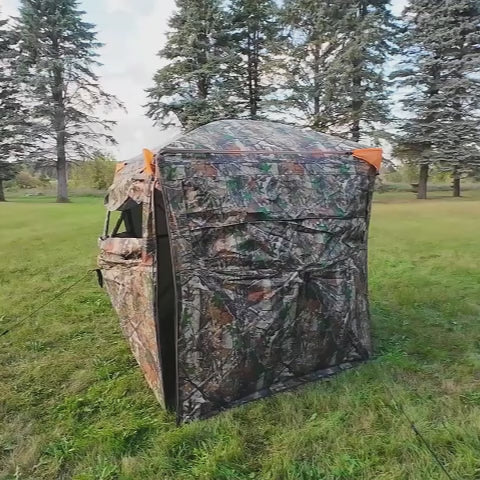
How Deer Learn and Adapt to Ground Blinds

Many hunters believe a ground blind fails because deer “get spooked.”
In reality, most failures happen long before a deer ever bolts.
Mature deer rarely panic without reason. Instead, they observe, remember, and adjust. A blind that works perfectly one season may quietly stop producing the next—not because deer disappeared, but because they learned.
Understanding how deer adapt to ground blinds is the difference between blaming luck and making smarter decisions in the field.
Deer Don’t Fear Blinds—They Learn From Them
Whitetails don’t automatically associate a ground blind with danger. In fact, many deer approach blinds calmly, sometimes within bow range, especially early in the season.
The problem begins when exposure repeats.
A deer that encounters a blind multiple times without incident still gathers information:
- Where it appeared
- When human scent lingered
- How movement or sound aligned with that structure
Over time, the blind becomes a reference point, not a threat—but one tied to subtle pressure.
This is why experienced hunters often say, “They didn’t blow out—they just stopped committing.”
Memory Is Built on Pressure, Not Panic
Deer learning is rarely dramatic. Most adaptation happens quietly.
A buck that smells faint human odor drifting from a blind one evening may still pass through. The next encounter, it slows. The third time, it angles downwind. Eventually, it changes timing or routes entirely.
This behavior explains a common scenario:
- Deer approach to 60–80 yards
- Pause briefly
- Drift away without alarm
Nothing feels wrong to the hunter—but something feels off to the deer.
Repeated Placement Creates Predictability
One of the fastest ways to educate deer is placing a blind in the exact same location season after season.
Even if the blind is brushed in well, deer begin associating that spot with:
- Altered wind patterns
- Ground scent buildup
- Human access trails
They may still pass through the area—but usually at a different angle or after dark.
Rotating blind locations by as little as 30–50 yards can be enough to disrupt this pattern. Changing the approach route often matters more than changing the blind itself.
Scent Accumulation Happens Before You Arrive
Most hunters think scent control starts when they enter the blind. In reality, it starts days earlier.
Repeated foot traffic compresses vegetation, traps scent, and creates invisible lanes that deer can read easily. Even with perfect wind on hunt day, ground-level scent often remains.
This is why deer sometimes circle downwind of a blind and leave without ever appearing nervous. They didn’t smell you—they smelled evidence of repeated human presence.
Reducing scent exposure means:
- Limiting unnecessary sits
- Varying entry and exit routes
- Avoiding overuse of a single blind location
Visual Changes Trigger Testing Behavior
Deer are extremely sensitive to environmental change.
A blind that suddenly appears, shifts position, or reflects light differently can trigger what looks like curiosity—but is actually testing behavior.
A deer may:
- Stop and stare from cover
- Move laterally while watching
- Approach cautiously, then retreat
This isn’t indecision. It’s evaluation.
Blinds with strong visual breakup and non-reflective fabric reduce these triggers. Designs like the Striker360 Diamond Camo Ground Blind, with its multi-angle camo geometry and full 360° visibility, help minimize hard edges and sudden movement silhouettes—especially when windows are managed correctly.
Movement Inside the Blind Teaches Faster Than You Think
Deer rarely see clear human shapes inside a blind—but they detect unnatural motion patterns instantly.
Quick head turns, shifting shoulders, or adjusting gear near open windows all create visual cues that deer log mentally.
Once movement aligns consistently with a specific structure, deer begin anticipating it.
The solution isn’t total stillness—it’s predictability control:
- Keep unused windows closed
- Wear dark interior clothing
- Move only when deer are obscured or distracted
A blind that allows controlled, low-profile movement gives hunters more margin for error.
When Deer “Know” a Blind—but Still Use the Area
One of the most misunderstood behaviors is when deer continue using an area but refuse to offer a shot.
They may:
- Pass just outside effective range
- Appear only at last light
- Approach from angles that limit visibility
This doesn’t mean the blind failed—it means deer adapted.
In these cases, the best decision may be resting the location entirely, or shifting focus to travel corridors rather than the original setup.
Staying Unpredictable Is More Effective Than Staying Hidden
Perfect camouflage won’t overcome repetition.
Deer adapt fastest to patterns, not mistakes. Hunters who succeed long-term treat blinds as temporary tools, not permanent fixtures.
If you can only change one thing:
- Change access routes first
- Then rotate timing
- Then rotate placement
Blinds like the Striker360 Diamond Camo Ground Blind offer flexibility for repositioning without sacrificing coverage, making them better suited for adaptive setups rather than fixed locations.
Final Thoughts: Adaptation Is a Two-Way Process
Deer are not outsmarting hunters—they are responding logically to pressure.
When a ground blind stops producing, it’s rarely because deer fear it. It’s because they’ve learned how to navigate around it.
The most effective hunters don’t ask, “Why didn’t that deer commit?”
They ask, “What pattern did I teach it?”
Adapt faster than the deer, and the blind becomes an advantage again—not a liability.